Stop guessing which nights earn their tables.

You already have players. Tabletop Lynk tells you what they actually do: who signed up, who turned up, which nights fill, and which ones quietly stopped being worth the space. Run your events on numbers instead of a feeling.

30 day trial. Works from your first event, with the players you already have.

Why it matters

You know your events are running. Do you know how they are doing?

Most venues run on memory. Thursday "feels busy." Wednesday "has been quiet lately." Someone said they were coming and did not. You have a room, a finite number of tables, and a finite number of nights, and the decision about what to keep running is made on a hunch, because the numbers to make it properly have never existed anywhere.

Facebook tells you sixty people are "interested." Your group chat gives you a pile of thumbs up. Neither survives contact with a Tuesday night. Nobody is counting how many seats you offered versus how many were taken, how many people who said yes actually walked in, or whether the person who came for the first time last month ever came back.

If you run a business

Every table has a cost.

  • Your room, your hours, and your staff are finite. A night that half fills is occupying space a better night could use.
  • You decide what stays on the schedule without knowing which events actually hold their players.
  • People say they are coming and do not, and you order, staff, and set up as though they will.
  • When someone tries you once, nothing tells you whether they ever came back.
If you run a group

Every no show costs a volunteer.

  • A GM prepped for four hours and ran the night for three players instead of six. That cost lands on a person, not a balance sheet.
  • Signups live in a message thread, so the headcount is whatever you can piece together from reactions.
  • You are the only one holding the admin, and that is usually what ends up ending the group.
  • Nobody tells a volunteer why they stopped coming. They just stop.
What you get

The numbers, and the machinery that produces them.

Attendance, per night

Who actually showed up, night by night and broken down by event type. The record builds itself as you run events, so the comparison you need in six months exists in six months.

Signed up vs turned up

The gap between the two is the number nobody tracks and everybody feels. Seats offered, seats taken, and who did not arrive after saying they would.

A reliability record that follows the player

Players earn show up streaks that reset the moment they miss one. Reliability stops being a thing you remember about someone and starts being a thing you can see.

Per night signups

A recurring event is not one signup sheet. Players commit to the specific nights they can make, and seats refill per night when someone cancels, so the headcount is real.

Private feedback

Visitors can rate their visit and only you ever see it. Gated on real attendance and never shown publicly, so it is feedback rather than a review score that can follow you around.

A profile and calendar that do the admin

Your venue is the host, not a staff member's username. List, week, and month views, an address that opens in maps, and signups that do not need you to approve them one at a time.

A look at the board.

A few pieces of the dashboard every venue gets. Book a demo to see the whole thing with your own events in it.
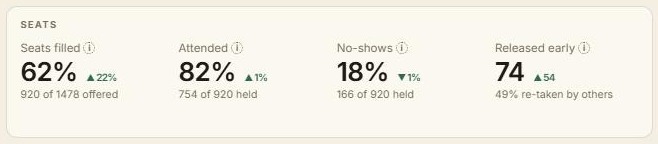
Seat tiles showing the share of seats filled, the share of players who attended, no-shows, and seats released early.
Seats, at a glance. How full your nights get, who turned up, and who did not.
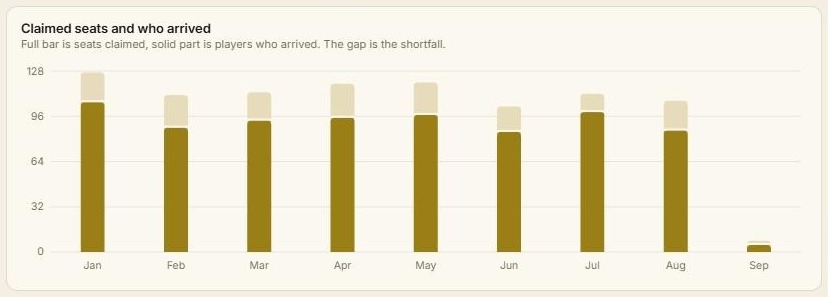
A monthly bar chart comparing seats claimed with players who actually arrived.
Signed up vs turned up. The gap between the two, month by month.
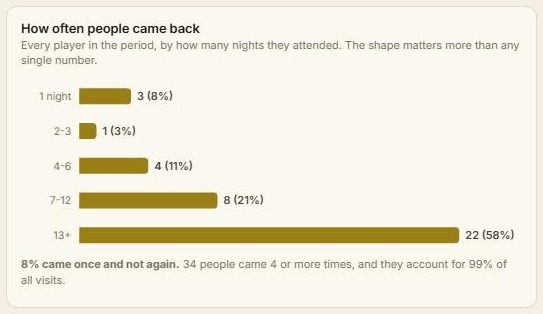
How many nights each player attended, grouped into bands from one night to thirteen or more.
Who keeps coming back. Your regulars, and the visitors who came once.
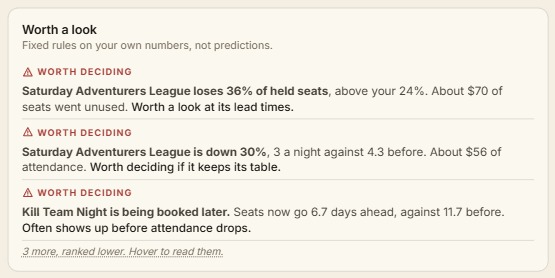
Three callouts ranked by what they cost: an event losing 36 percent of its held seats, the same event down 30 percent on attendance, and an event whose seats are being booked later than before.
What to look at next. Plain rules on your own numbers, not predictions.

*Players need their own account (available for 13+ only)

Where we are

We are new, and you should know what that means.

Tabletop Lynk launched on the App Store and Google Play in August 2026. We are not going to tell you there is a crowd of players in your city waiting to discover you, because we are currently building out our community. Any platform that promises a new venue instant demand is selling you something it does not have yet.

Here is why that does not matter for what this does. Everything on this page works with the players you already have. Your Thursday regulars sign up, check in, and build an attendance record from your very first event. The reporting is built on your daily performance metrics. These insights are valuable to your operations today. Discovery is the part that gets better as the player side grows.

What being early actually buys you. A short, direct line to the people building this, and real influence over what gets built next while the roadmap is still soft. Also a head start on your own data: the venue that starts recording attendance now is the one with a year of it next summer, and that comparison cannot be backfilled later.

Pricing

Two tiers, by what you are.

One rate, and a standing discount for groups that are not a business. Same features either way.

For profit

Business

$59.99 / month

The full rate. For game stores, cafes, and any venue running events as part of a business, priced for a room that pays rent.

Volunteer run

Community

Was $59.99, now $19.99 / month

Two thirds off the full rate

If you are not running events as a business, you pay a third of the price. For city Adventurers League chapters, hobby clubs, and groups that pass a hat for snacks. Same tools, no strings, no expiry on the discount.

*Both tiers include a 30 day trial.

Good to know

  • Running monthly events? We will stretch your trial to fit.
  • Nothing is deleted when a subscription ends.
  • Cancel anytime from your billing portal.
  • Your regulars are yours: we never use your attendee list to promote other venues.
Getting started

How it works.

Tell us about your venue

Send us a note with your venue's name, where you are, and what you run. We set the venue up and connect it to your Tabletop Lynk account.

Point your regulars at it

Post your events as your venue, then send your existing crowd the link. You do not need anyone new for this to start working, you need the people already coming on Thursday.

Start building the record

Signups, check ins, and attendance accumulate from night one. Within a couple of months you can answer questions about your own events that you could only guess at before.

Start measuring this season, not next year.

Tell us about your venue and we will set up a time to walk you through the full dashboard. We are small enough that a real person reads every one of these, and small enough that what you ask for can still change what we build.

We use what you send here only to reply to you about your venue. See our Privacy Policy.

Request sent

We will email you at the address you gave us to set up a time.